Click Here to Download the PDF
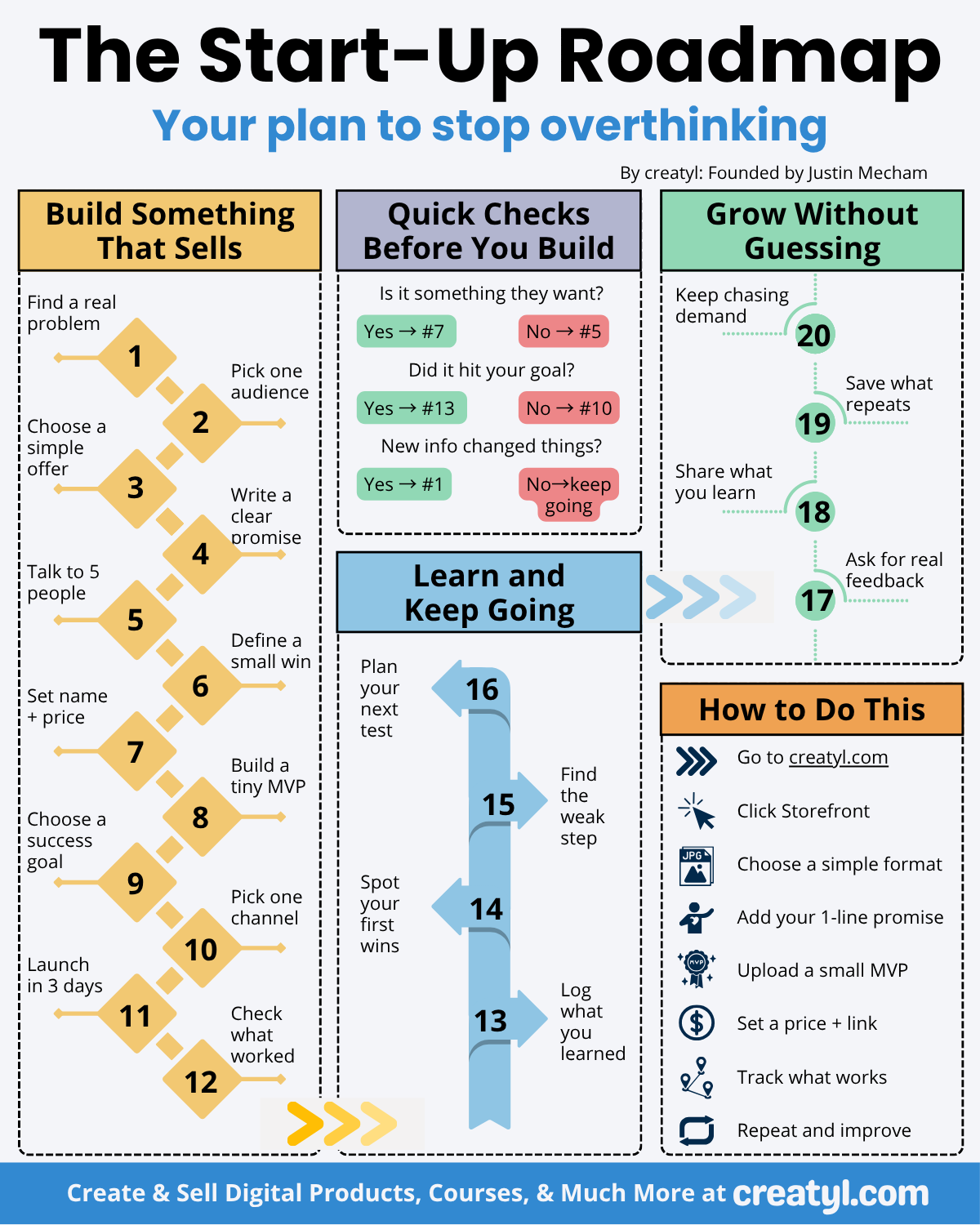
Most products don’t fail because the idea is bad.
They fail because they never make it past the drawing board.
And if we’re being honest, most people never get stuck because of the work.
They get stuck because of the overthinking.
We tell ourselves we need more time, a stronger plan, the perfect platform, or a clearer niche.
But behind all those delays is something harder to admit: fear.
Fear that the product won’t be good enough.
Fear that we’ll embarrass ourselves if no one buys.
Fear that we’re not quite ready.
But readiness isn’t what gets results. Action does.
That’s why this roadmap matters.
It gives you a way to move forward without waiting for confidence.
It’s designed to help you go from stuck in your head to launched in the world—without all the guesswork.
And the truth is, most people don’t need more time. They just need a way to start.
The Real Roadmap to Building Something That Sells
If you’ve ever sat on an idea for months—or even years—this roadmap is your get-out-of-the-loop card.
It’s not for building a massive course or perfect brand.
It’s for building something small that solves one real problem.
Here’s how it works:
You start by getting honest about the pain point you want to solve.
Not a vague niche like “mindset” or “productivity.”
But a real, sharp problem someone is actively struggling with.
Then you get specific: who has this problem? Who feels this daily?
Pick one audience. Not “everyone.” Not “creators.”
One group of people you can actually talk to.
Once you’ve got that, your job is to write a single, clear promise.
One sentence. Plain language. No jargon.
Then come the action steps:
- Talk to five real people in your audience. Ask them about the problem. Listen more than you speak.
- Define one tiny result your product will deliver. Just one.
- Name your product. Price it. Keep it simple.
- Build a micro-version—a tiny MVP that helps them get that win.
- Choose one place to share it. Maybe it’s your email list. Maybe LinkedIn. Maybe a Slack group.
- Launch it within 72 hours. Not someday. Not “after the holidays.”
- Pay attention to what happens next.
This is how you move from idea to income—and more importantly, from overthinking to momentum.
Quick Checks That Keep You Out of the Spiral
Once your MVP is out there, don’t freeze up or assume the next step is scaling immediately.
Ask yourself three questions before you take another leap:
- Is this something people truly want?
- Did it hit the specific goal you set?
- Has any new information changed your direction?
If the answer is yes to any of these, make the necessary adjustments.
If the answer is no, keep moving.
The goal isn’t to chase certainty. The goal is to move with clarity, one test at a time.
Keep Learning, Keep Moving
Once you launch, the work isn’t over.
But this part? It gets exciting.
You get to watch how real people interact with something you built.
You get data. Reactions. Feedback. Wins. Questions.
Here’s how to keep learning:
- Log everything you learn. Every email, every DM, every “I didn’t get it” moment.
- Spot early wins. Don’t dismiss the first three sales or first compliment. That’s signal.
- Find the weak spot. What part confused people? What step got skipped?
- Plan your next test. You’re not rebuilding. You’re refining.
The smartest creators don’t wait for a perfect relaunch. They stay in motion. They learn in public.
How to Grow Without Guessing
If you’ve launched once, you’re already ahead of most people.
Now it’s time to stop guessing—and start building based on what’s working.
This part is simple but powerful:
- Keep chasing what people are already asking for.
- Ask for honest, specific feedback.
- Share your behind-the-scenes process and lessons. People love seeing what’s real.
- Save what works. When something repeats, make it a system. Turn it into your next product, your content, or your onboarding.
You don’t need to be a genius to grow. You just need to pay attention.
Real-Life Workplace Examples
Example 1: The Consultant With Too Many Ideas
A leadership consultant had a backlog of half-finished products: a 10-module course, an eBook, a webinar funnel, a podcast outline.
They couldn’t decide what to focus on.
Every time they sat down to build, they jumped to a new idea.
Six months passed. Nothing was launched.
Their email list had gone quiet.
They were burned out from building and had no feedback or revenue to show for it.
They got clear on one thing: helping new managers run their first performance review.
After talking to five past clients, they confirmed it was a common fear.
They created a two-page script + checklist, priced it at $15, and launched it in a LinkedIn post with a simple message:
“If your first review is coming up, this will help.”
Within a week, they had 32 sales and 4 requests for custom versions.
That one launch gave them the confidence to keep going, using the roadmap step-by-step.
Today, they’ve built a full toolkit of products—all validated in real time.
Example 2: The Team That Overbuilt Their Internal Tool
A startup’s product team spent weeks building a client onboarding dashboard.
It was feature-rich, automated, and beautifully designed. But when they rolled it out to new clients, hardly anyone used it.
The leadership team started asking questions.
Why were onboarding questions still going to support?
Why were customers still asking for the same checklist?
It was a wake-up call: they had built something clever, not something useful.
They took a step back and reviewed feedback.
They ran quick checks:
Did it hit the goal? No.
Did users want it? No.
Had anything changed? Yes—clients wanted clarity, not automation.
In 72 hours, they built a Notion doc with three onboarding steps, a checklist, and two example templates.
Sent it to new users. Engagement skyrocketed.
Clients shared it with their teams.
The old dashboard was archived.
The simple MVP became their most-used resource.
Example 3: The Coach Who Kept Rewriting a Course
A career coach was building a flagship course.
It had everything: 8 modules, 30 lessons, video walkthroughs, PDFs. But after 7 months, nothing had been launched.
They kept second-guessing the structure, redesigning the slides, and worrying the price was wrong.
Meanwhile, their audience kept asking, “When is it launching?”
Their confidence took a hit.
They went back to basics.
Chose one small win: writing a better professional bio.
They built a five-slide training with a worksheet.
Named it “The Modern Bio,” priced it at $12, and sent it to their email list.
In 72 hours, 56 people bought.
Many replied asking for resume help. T
hat tiny launch turned into 3 coaching clients. Instead of building everything, they built one useful thing.
And that changed everything.
Example 4: The Marketer Who Didn’t Know What to Sell
A freelance email marketer wanted to sell a digital product but didn’t know what people would pay for.
They watched what competitors were doing, kept starting outlines, and never finished anything.
They spent months stuck in comparison.
Their audience wasn’t growing.
Their confidence dipped every time they scrolled Twitter.
One day, they reviewed past client emails and realized a common theme: “Can you just write a launch sequence for me?”
They pulled a favorite from a past campaign, turned it into a 3-email template pack, and added a one-page guide.
Priced it at $25. Shared a personal story and link.
Within a week, it had been retweeted 40+ times and made $800.
More importantly, people asked for versions for Black Friday, product launches, and waitlists.
Instead of guessing what to create, they started listening to what people already wanted.
The Best Book That Aligns With This Roadmap
If there’s one resource that perfectly captures this mindset and method, it’s this:
Book: The Lean Startup: How Today’s Entrepreneurs Use Continuous Innovation to Create Radically Successful Businesses
Author: Eric Ries
This book laid the foundation for how startups test ideas quickly, get feedback fast, and avoid overbuilding.
It introduced the idea of MVPs (minimum viable products) to a global audience—and proved that you don’t need scale or polish to succeed.
You need results.
The roadmap you’ve been reading?
It’s a real-world, simplified application of the Lean Startup method.
If you want a deeper understanding of why this works, this book is the place to start.
You’re Not Behind. You’re Just One Launch Away From Clarity.
The hardest part of building something new isn’t the platform or the pricing.
It’s getting past the part of you that wants to be 100% sure before starting.
But clarity isn’t something you find in your head. It’s something that shows up after you take action.
You don’t need to have it all figured out.
You don’t need a perfect product. You just need a place to begin.
The people who grow their audience, their revenue, their reach—they aren’t always more talented.
They’re just more willing to put something real into the world before they feel ready.
The roadmap doesn’t ask you to be fearless.
It just gives you something to do instead of getting stuck.
You don’t have to feel behind. You’re not late.
You’re one simple product away from knowing exactly what to do next.
And that’s where everything starts to change.
Download the Roadmap Infographic
Want the visual roadmap from this article as a printable PDF?
Download it and keep it nearby as you build, test, and launch.