Click Here to Download the PDF.
Do Not Quit Into Nothing: A Practical Plan for Building Your Next Chapter While You Are Still Employed
The Question That Changes the Entire Exit Conversation
There is a moment many people quietly imagine during a difficult workweek.
You picture opening your laptop, writing a short resignation letter, and finally pressing send. You imagine the relief of no longer attending the meetings you dread, answering to the person who drains you, or giving your best hours to work that no longer feels meaningful.
For a few minutes, quitting seems like the answer to everything.
Then a harder question appears:
What would you actually be walking into?
That question changes the conversation because it separates relief from readiness.
Leaving a painful situation can create immediate emotional relief, but relief is not the same as security. It does not automatically create customers, income, structure, direction, or a better use of your time.
Without something solid on the other side, the stress you escaped can quickly be replaced by a different kind of pressure.
The bills still arrive.
Savings start shrinking.
Every slow sales week feels personal.
Every uncertain idea begins carrying the weight of your entire future.
That is why the smartest exit plans are rarely built in one dramatic moment.
They are built quietly, through a series of practical decisions made before the resignation letter is ever written.
The goal is not simply to leave your job.
The goal is to build enough financial room, buyer proof, repeatable income, and personal confidence that leaving becomes a thoughtful choice rather than an emotional reaction.
A Strong Reason to Leave Is Not the Same as a Strong Place to Go
You can have a completely valid reason to leave and still be unprepared to do it.
Your work may be draining you. Your manager may be difficult. Your role may no longer fit your values, ambitions, or life.
You may have reached the point where staying indefinitely would cost more than changing direction.
None of that automatically means tomorrow is the right day to resign.
This distinction can feel frustrating because it sounds as though you are being told to tolerate a bad situation.
That is not the point.
The point is to stop giving one difficult day the power to determine the next several years of your life.
An impulsive exit is controlled by the situation you are trying to escape. An intentional exit is controlled by the future you are building.
One says, “I cannot take this anymore.”
The other says, “I have built enough options to choose what comes next.”
Both may lead to leaving, but they produce very different experiences afterward.
Why Escape Plans Often Collapse
A plan built entirely around getting away from something usually has one major weakness: it becomes less motivating once the immediate pain disappears.
While you are frustrated at work, energy can feel endless.
You imagine working on your own business every morning, creating offers, finding customers, and finally controlling your time.
Then you quit.
For a few days, the relief feels incredible.
After that, the work becomes real.
You still need to choose a problem worth solving. You still need to create an offer. You still need to speak with potential buyers, make sales, deliver results, handle administration, and continue showing up when nobody is managing your calendar.
Frustration can push you out of a job, but it is not a reliable operating system for building a business.
That is why a strong exit needs more than anger, exhaustion, or the belief that you could do something better. It needs four foundations:
- A financial runway that gives you room to think.
- Proof that real people will pay for your idea.
- A repeatable system that does not rely on constant improvisation.
- Clear conditions that define when leaving is financially and personally sensible.
Without those foundations, you may leave one source of pressure only to create several new ones.
Move One: Build Financial Runway Before You Need It
Runway is not only money in a savings account. It is decision-making space.
When you have little financial room, every opportunity feels urgent. You are more likely to accept poor-fit customers, underprice your work, overpromise, or chase ideas that offer quick money without creating a business you actually want.
Savings reduce that pressure.
They allow you to reject work that would pull you in the wrong direction.
They give new offers enough time to produce useful feedback. They help you respond to slow months with analysis rather than panic.
Start by calculating what leaving would actually require.
Do not begin with your current salary. Begin with your real monthly needs.
List your essential expenses:
- Housing
- Food
- Utilities
- Insurance
- Transportation
- Debt payments
- Healthcare
- Family responsibilities
- Core business costs
- Taxes
- A reasonable buffer for unexpected expenses
Separate genuine needs from spending that could be reduced during a transition.
This is not about creating a miserable life. It is about understanding the lowest realistic number that would let you operate calmly.
Once you know that number, decide how much runway you need.
The right amount depends on your responsibilities, industry, health, household income, and tolerance for uncertainty.
Someone supporting a family may need significantly more room than someone with lower fixed costs and another reliable household income.
The goal is not copying someone else’s number. It is knowing your own.
Reduce Pressure Before Increasing Risk
Many people focus only on earning more when preparing to leave. Lowering unnecessary expenses can be equally powerful.
Every recurring expense you remove reduces the monthly income your new business must replace. A smaller required number gives you more options and more time.
Review subscriptions, convenience spending, high-interest debt, unused services, and lifestyle costs that no longer provide enough value.
Do not make random cuts that make everyday life unbearable. Remove expenses that create little benefit but increase the pressure placed on your future business.
Financial runway does more than delay danger. It changes your behavior.
You negotiate differently when you are not desperate.
You price differently when one customer is not responsible for your survival.
You think more clearly when a disappointing week does not immediately threaten your home.
That calm is an operating advantage.
Move Two: Prove the Idea Before Building the Full Business
An idea is not proof.
Compliments are not proof.
Likes are not proof.
Friends saying, “You should definitely do that,” are not proof.
Payment is proof.
Before leaving a reliable salary, you need evidence that people outside your imagination believe the problem is important enough to spend money solving.
This does not require building the complete version first. In fact, doing so can delay the information you need most.
Create the smallest useful version of your offer.
That might be:
- A paid consultation
- A live workshop
- A short guide
- A template
- A checklist
- A small coaching package
- A limited test group
- A simple done-for-you service
The first version should solve one narrow problem for one recognizable type of person.
It does not need to represent your entire future company.
It only needs to answer the first important question:
Will anyone pay me to create this result?
Start With a Problem People Already Feel
Weak offers often begin with the creator’s interests.
“I want to teach leadership.”
“I want to make a productivity course.”
“I want to help people start businesses.”
Those are broad subjects, not clear problems.
A stronger offer begins with a situation the buyer already wants to change.
For example:
“I help newly promoted managers run useful one-on-one meetings without wasting time.”
“I help independent consultants turn scattered expertise into one clear paid offer.”
“I help small teams replace repeated status meetings with a simple weekly update system.”
The more clearly people recognize their current problem and desired result, the easier it becomes for them to understand why the offer matters.
Ask for Money Earlier Than Feels Comfortable
Many aspiring business owners delay selling because they want to perfect the product first.
But selling is not the final step in validation. It is the central step.
A person joining a free waitlist may be curious. A person paying has made a decision.
That does not mean manipulating people into buying an unfinished promise. Be transparent about what exists, what is being tested, what they will receive, and when it will be delivered.
An early paid test can be simple:
“I am running a small pilot for five people who want to achieve this result. It will include these three parts, take place over this period, and cost this amount. Because it is the first version, I will be closely involved and use your feedback to improve it.”
That is honest, useful, and far more informative than building alone for six months.
Move Three: Turn Successful Effort Into a Repeatable System
A side business can generate money and still fail to create freedom.
This happens when every sale, delivery, follow-up, and customer question depends entirely on your memory and constant personal effort.
You may be earning, but you have built another job.
The next stage is not immediate automation. It is documentation.
Write down what happens repeatedly.
How do buyers first hear about you?
What questions do they ask before purchasing?
What information helps them decide?
How do you deliver the work?
Which parts create the best result?
Where do customers get confused?
What do you repeat in every email, call, or project?
Once repeated work becomes visible, you can begin simplifying it.
Create templates for common messages. Build a standard onboarding checklist. Use one place for customer files. Record explanations you give repeatedly. Create clear delivery milestones. Set a weekly rhythm for selling, fulfilling, and reviewing the business.
Systems do not need to be advanced to be valuable.
A simple checklist used consistently can create more stability than expensive software used without a clear process.
Remove Yourself From the Wrong Work
The goal is not to remove yourself from everything. Your knowledge, judgment, and relationships may remain central to the business for a long time.
The goal is to stop personally recreating work that should already have a reliable process.
You should not need to remember every onboarding step.
You should not write the same welcome email from the beginning every time.
You should not search through old conversations to find a document buyers receive regularly.
You should not spend your best thinking time on tasks that can be handled through a checklist, template, scheduled message, or basic tool.
Each repeated task you simplify gives you more time for work that requires your actual judgment.
That is how the business gradually becomes less fragile.
Move Four: Choose Your Exit Conditions Before Fear Chooses Them for You
One of the most important parts of an exit plan is deciding in advance what “ready enough” means.
Without clear conditions, you can fall into one of two traps.
The first is leaving too early after one painful day.
The second is delaying forever because no amount of proof feels safe enough.
Create an exit readiness checklist before emotions are high.
Your conditions might include:
- A specific number of months of personal expenses saved
- Side income consistently covering a set percentage of essential costs
- Several months of repeat sales
- More than one reliable customer acquisition path
- No single customer representing a dangerous share of revenue
- A documented delivery process
- Clear evidence that buyers receive meaningful results
- A realistic health insurance, tax, and retirement plan
- Agreement with a spouse or partner
- A transition date that avoids unnecessary financial or contractual damage
These are not universal rules. They are decision filters.
The purpose is to stop fear and frustration from changing the standard every week.
Revenue Alone Is Not Enough
A single strong month may feel like proof that you are ready. It may also be an unusual spike.
Look for patterns.
Are customers returning?
Are referrals appearing?
Can you explain where the next buyers are likely to come from?
Is demand tied entirely to one launch, one platform, or one client?
Can the business survive a slower month?
Does delivering the work leave enough time to continue selling it?
Reliable income matters more than impressive income that appears once.
The strongest signal is not one large payment. It is evidence that the process can happen again.
Impulse Versus Intention
Quitting impulsively often follows a familiar sequence.
A terrible meeting happens. A manager crosses a line. A project becomes unbearable.
The thought of staying another month feels impossible.
Resignation becomes the fastest available way to feel control again.
Intentional exits behave differently.
They still take pain seriously, but they do not allow pain to make every decision.
An intentional plan says:
“I will not ignore what this job is costing me. I will also not allow it to push me into a future I have not prepared for.”
That is not weakness. It is self-protection.
The differences are practical.
Impulse quits after one awful day. Intention collects enough information to distinguish a bad week from a role that truly needs to end.
Impulse builds without speaking to buyers. Intention validates demand before increasing the commitment.
Impulse depends on one customer because the first money feels urgent. Intention builds more than one path to revenue.
Impulse assumes motivation will remain high. Intention creates routines that still function during difficult weeks.
Impulse says, “I will figure it out after I leave.” Intention starts figuring it out while the paycheck still provides room to learn.
The Job Can Become the Investor
One of the most useful mental shifts is seeing your current job differently while you build.
It may no longer be your final destination. It can still serve a purpose.
The paycheck can finance savings.
It can cover basic expenses while you test offers.
It can allow you to learn without requiring each attempt to succeed immediately.
It can fund tools, education, professional advice, and early business costs.
It can give you access to problems, people, and systems that teach you what the market needs.
This does not mean romanticizing a harmful workplace.
If your safety or health is at serious risk, the timeline may need to change quickly, and professional support may be appropriate.
But when the situation is difficult rather than dangerous, changing the meaning of the job can reduce the feeling of being trapped.
You are no longer only working for your employer.
Part of that income is buying future choice.
That shift can make the current season easier to tolerate because it now has a defined purpose and an endpoint.
The First Sale Changes More Than Your Bank Balance
The first sale rarely creates financial freedom.
It creates psychological freedom.
Before that moment, your business exists mainly as a possibility.
You believe your skill could be useful, but you do not know whether anyone will exchange money for it.
Then someone pays.
The amount may be modest, but the meaning is not.
It proves that your knowledge has value beyond your current title and employer.
It proves that you can identify a problem, offer help, and create a result someone wants.
It replaces a dangerous belief:
“My paycheck is my only option.”
With a more useful one:
“I can build another option.”
That belief changes how you approach everything that follows.
You become less dependent on motivation because you now have evidence.
You begin paying closer attention to customer questions.
You improve the offer based on real use rather than imagination.
You start seeing the business not as an escape fantasy but as a set of skills you can develop.
The first sale is not the finish line.
It is the first piece of reality.
A Realistic Consulting Example …
I once worked with a professional who was ready to leave a demanding operations role.
They had spent years managing complex projects, building internal processes, and solving problems that saved their employer significant time.
They were tired of being the person called whenever something broke. The workload kept increasing, recognition remained limited, and each Sunday evening brought the same heavy feeling.
They wanted to resign immediately and begin consulting.
The idea made sense on the surface. They had experience, strong results, and a valuable skill set.
But when I asked how many potential clients they had spoken with, the answer was none.
They had no defined offer, no pricing, no buyer conversations, and no savings target.
They had a reason to leave, but the business they planned to enter existed mostly in their head.
The danger was not that they lacked ability. The danger was that financial pressure would force them to make poor business decisions before they had learned what buyers wanted.
Without runway, every prospect would feel essential.
Without a clear offer, each sales conversation would become a custom explanation.
Without proof, pricing would feel like guessing.
Without a repeatable process, every new customer would require rebuilding the service from the beginning.
Quitting might have produced immediate relief, but the resulting uncertainty could have made them accept any work available. Instead of building a focused consulting business, they risked creating a collection of stressful projects with demanding clients and inconsistent income.
The original job had become painful, but leaving too soon would not automatically create a better situation.
We built a four-part plan.
First, they calculated essential monthly expenses and created a savings target that would provide several months of breathing room.
Second, we reviewed the work colleagues and industry contacts repeatedly asked them to help with.
One issue appeared again and again: teams had poor internal processes and lost hours every week to unclear handoffs.
Third, they created a small paid operational review rather than launching a broad consulting business.
The offer included a short assessment, one workflow map, and three recommended improvements. It solved one clear problem and was small enough to deliver after work.
Fourth, after completing several reviews, they documented the process. They created standard intake questions, a repeatable analysis checklist, a report template, and a follow-up structure.
The first offer did not replace their salary. It did something more important at that stage: it generated buyer proof.
Clients paid.
Several implemented the recommendations.
One returned for a larger project.
Another made a referral.
Over the following months, the person built savings, clearer positioning, repeatable delivery, and several reliable relationships. By the time they resigned, they were not stepping into a blank space.
They were stepping into a business that had already begun.
What to Build First
When people think about leaving a job, they often imagine a complete business with several offers, polished branding, a large audience, and automated marketing.
That is too much to prove at once.
Start with one offer that can generate three kinds of evidence:
- Buyer evidence: someone is willing to pay.
- Delivery evidence: you can create the promised result.
- Repeatability evidence: the process can work more than once.
A service is often the fastest way to gather this information because you work directly with the buyer and hear their questions in real time.
Those conversations can later shape a guide, course, template, membership, or other product.
You are not committing to the first format forever.
You are choosing the format that teaches you the most quickly.
Questions That Reveal Whether Your Idea Is Ready
Before building the larger version, ask:
- Who feels this problem strongly enough to act now?
- What have they already tried?
- What does the problem cost them in time, money, stress, or missed opportunity?
- What specific result can I help create?
- How quickly can the buyer experience a useful win?
- Can I explain the offer in one sentence?
- Have I spoken with at least five people who fit the audience?
- Has anyone paid, preordered, or made a serious commitment?
- What did buyers value most after using it?
- Which part of delivery should become a repeatable process?
These questions force the business out of your imagination and into contact with reality.
A 90-Day Build-Your-Exit Plan
Days 1–30: Create Financial and Market Clarity
Calculate your monthly needs and initial runway target.
Review the skills people already ask you to use.
Choose one problem that is painful, specific, and connected to a group you can reach.
Speak with potential buyers before creating the full offer.
Ask how they currently deal with the issue, what frustrates them most, and what a useful result would look like.
At the end of the first month, you should have a clear audience, a clear problem, and a small paid offer you can describe simply.
Days 31–60: Sell and Deliver the First Version
Invite a small number of people to purchase the pilot. Be honest that it is an early version. Set clear expectations, scope, price, and timing.
Deliver closely enough to observe what works. Record the questions buyers ask, the steps they struggle with, the language they use, and the parts they value most.
Do not rush to add more features. Improve the result.
Days 61–90: Create the Repeatable Process
Turn repeated actions into checklists and templates. Clarify your sales message using the language buyers used. Ask for specific feedback and short testimonials when appropriate.
Review the numbers:
- How many conversations produced a sale?
- How much time did delivery require?
- What did each customer cost you to acquire?
- Which steps can be simplified?
- Would you want to keep delivering this offer?
- What needs to change before serving more people?
At the end of ninety days, you may not be ready to resign. You should, however, possess far more useful information than another ninety days spent thinking about leaving.
Warning Signs That You Are Building Another Trap
A side business should create options. It can also become another source of exhaustion if built carelessly.
Watch for these warning signs:
One Customer Controls Everything
If one buyer represents most of your income, you have replaced one employer with another powerful dependency.
Work toward a healthier mix before making major decisions.
Every Sale Requires a Completely Different Offer
Customization may be valuable, but excessive variation makes the business difficult to explain, price, and deliver.
Look for the common problem underneath the different requests.
You Cannot Stop Working Without Revenue Stopping Immediately
Early businesses often depend heavily on the owner. Still, repeated work should gradually become easier, clearer, and less dependent on constant reinvention.
You Are Building From Resentment
A business designed only to prove something to your former employer can lead you toward work you do not actually want.
Build around the life and problems you want to serve, not merely the situation you want to escape.
Your Health Is Declining
Building outside full-time work requires honest limits. A plan that destroys your energy before it creates income is not sustainable.
Reduce scope, extend the timeline, or remove low-value commitments rather than treating exhaustion as evidence of commitment.
Resources Worth Exploring
Book: The $100 Startup by Chris Guillebeau
This book explores how people have used existing skills and small amounts of capital to create practical businesses. Its strongest lesson is that useful offers and real customers matter more than elaborate planning.
Book: Company of One by Paul Jarvis
A valuable read for anyone who wants to build a profitable, manageable business without automatically chasing a larger team, more overhead, or endless complexity.
Book: The Mom Test by Rob Fitzpatrick
This is one of the most practical resources for learning how to speak with potential customers without collecting polite but misleading feedback. It helps turn vague conversations into useful evidence.
Podcast: The Side Hustle Show with Nick Loper
The show features practical examples of people building income alongside regular employment. It is particularly useful for seeing how small offers and focused experiments can develop over time.
Practical Tool: A Monthly Exit Dashboard
Track only the information that helps you make the decision:
- Essential monthly expenses
- Savings runway
- Side-business revenue
- Repeat revenue
- Number of active customers
- Percentage of income from the largest customer
- Leads generated
- Sales conversion rate
- Delivery hours
- Personal energy and stress
Money matters, but readiness is not purely financial. Your business also needs enough demand, structure, and personal sustainability to continue after the paycheck disappears.
Do Not Leave Only Because Staying Hurts
Pain can reveal that something needs to change.
It cannot always tell you what the next change should be.
That is why the most important question is not simply, “How quickly can I leave?”
It is, “What am I building that will still make sense after the relief wears off?”
You do not need to remain indefinitely in work that is wrong for you. You also do not need to turn one difficult season into a rushed decision that creates years of unnecessary pressure.
There is another path.
You can take your frustration seriously without allowing it to control you.
You can save quietly.
Test an idea.
Ask people to pay.
Learn what creates results.
Document what works.
Reduce your dependence one step at a time.
Each action changes your position.
The first saved month gives you room.
The first sale gives you evidence.
The first repeat buyer gives you confidence.
The first clear system gives you stability.
Eventually, your job is no longer the only thing standing between you and financial fear. It becomes one source supporting a future you are actively creating.
That is when leaving changes.
It is no longer a desperate attempt to make pain stop.
It becomes a decision to move toward work, income, and a life you have already started building.
You may not know the exact day you will leave.
You do not need to.
You need to know that each month you are becoming less dependent on permission, less controlled by fear, and more capable of choosing what happens next.
The strongest exit is not the fastest one.
It is the one that allows you to sleep the night before, wake up the morning after, and know you are walking into something real.
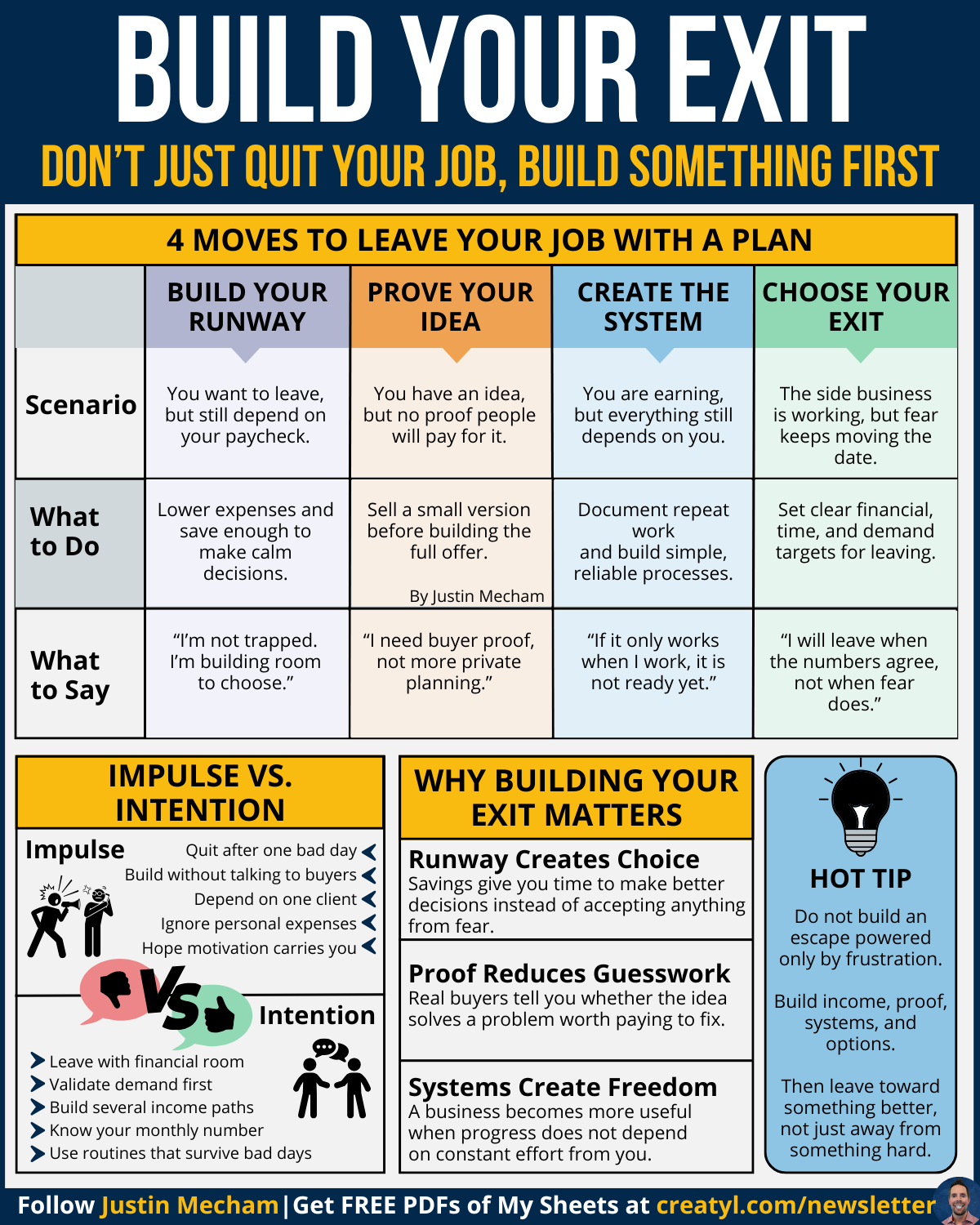
Download the “Build Your Exit” Infographic
Use the attached Build Your Exit framework to evaluate your financial runway, prove your offer, create repeatable systems, and define the conditions that will let you leave your job with greater clarity and control.