Click Here to Download the PDF.
Most leaders spend years trying to lead the “right” way.
They borrow traits from other people.
They soften parts of themselves.
They push harder where it doesn’t feel natural.
Not because they are bad leaders.
But because no one ever helped them name how they lead.
Leadership doesn’t break when a style is different.
It breaks when that style is unconscious.
Every leader has strengths.
Every strength carries a risk.
The goal is not to become a new kind of leader.
The goal is to understand the one you already are.
Why Leadership Styles Get Misread
Teams don’t struggle because leaders lack skill.
They struggle because behaviors are misinterpreted.
Decisiveness looks like aggression.
Calm looks like distance.
Support looks like avoidance.
Energy looks like chaos.
When people don’t understand the “why” behind a leader’s behavior, trust erodes quietly.
Clarity changes that.
Once a leader understands their natural style, they can lead with it instead of against it.
Red Leadership: Bold, Direct, and High-Intensity
Red leaders move fast.
They take charge in uncertainty.
They push through hesitation.
They bring momentum when things stall.
This energy is powerful in moments that need direction.
The risk appears when speed replaces listening.
Red leaders can unintentionally overpower quieter voices or push past warning signs.
They may carry too much weight alone and burn out over time.
When Red leaders pause to invite input and share the load, their strength becomes sustainable instead of exhausting.
Blue Leadership: Calm, Clear, and Steady Under Pressure
Blue leaders bring logic to chaos.
They stay composed when others panic.
They think carefully before acting.
They build plans that hold up over time.
Teams often feel safe with Blue leaders during high-stress moments.
The challenge shows up in perception.
Silence can be mistaken for distance.
Thoughtfulness can look like delay.
When Blue leaders explain their thinking out loud and name timelines clearly, people feel included instead of left guessing.
Green Leadership: Supportive, Relational, and Trust-Focused
Green leaders care deeply about people.
They notice how others are feeling.
They create environments where voices are heard.
They prioritize relationships and trust.
This style strengthens teams in meaningful ways.
The risk is avoiding discomfort.
Hard conversations may get postponed.
Decisions may linger too long.
When Green leaders pair care with clarity, they protect trust while still moving forward.
Yellow Leadership: Optimistic, Creative, and Idea-Driven
Yellow leaders bring light into the room.
They energize teams.
They generate ideas.
They see possibilities others miss.
This style sparks creativity and momentum.
The challenge appears in follow-through.
Ideas may outpace structure.
Risks may be overlooked.
When Yellow leaders ground ideas in clear steps, energy turns into real progress instead of scattered motion.
Purple Leadership: Visionary and Big-Picture Focused
Purple leaders think long-term.
They connect dots across time.
They define direction and purpose.
They inspire through vision.
This perspective helps teams understand where they are going.
The risk is distance from day-to-day reality.
Details can get missed.
Execution gaps may grow.
When Purple leaders stay close to operations and check in on progress, vision becomes actionable instead of abstract.
Orange Leadership: Action-Oriented and Results-Driven
Orange leaders move.
They push ideas into motion.
They thrive in fast-paced settings.
They motivate others through action.
This style creates momentum quickly.
The challenge is pace.
Others may feel rushed.
Rest can be overlooked.
When Orange leaders slow the pace just enough to listen and reflect, action stays strong without burning people out.
When Style Clashes Looked Like Performance Issues
They were part of a leadership team managing a growing department.
Each leader cared deeply.
Each brought different strengths.
But tension was rising.
Some felt pushed.
Others felt unheard.
Decisions felt uneven.
Feedback became guarded.
Meetings felt tense instead of productive.
People quietly labeled each other as “difficult” or “checked out.”
The work itself was solid.
The friction came from misunderstood leadership styles.
Instead of forcing alignment, the team named their styles.
They identified who led with speed, who led with care, who led with vision, and who led with structure.
They adjusted communication:
- Fast leaders paused to ask for input
- Quiet leaders shared their thinking earlier
- Support-focused leaders set clearer boundaries
- Vision-focused leaders stayed closer to execution
Once styles were visible, tension eased.
Trust improved not because people changed—but because they understood each other.
You Don’t Need to Change Your Color
Leadership doesn’t require becoming someone else.
It requires awareness.
When you know your style, you can:
- Use your strengths on purpose
- Watch for your blind spots
- Communicate your intent clearly
- Lead with confidence instead of force
Power doesn’t come from control.
It comes from clarity.
Self-Awareness Is the Quiet Advantage
Why Leaders Who Know Themselves Lead Better
Great leadership doesn’t start with strategy.
It starts with self-awareness.
When leaders understand how they naturally show up, they stop fighting themselves.
They stop guessing how they are perceived.
They lead with intention instead of reaction.
Teams feel that shift immediately.
Not because leadership becomes perfect.
But because it becomes clear.
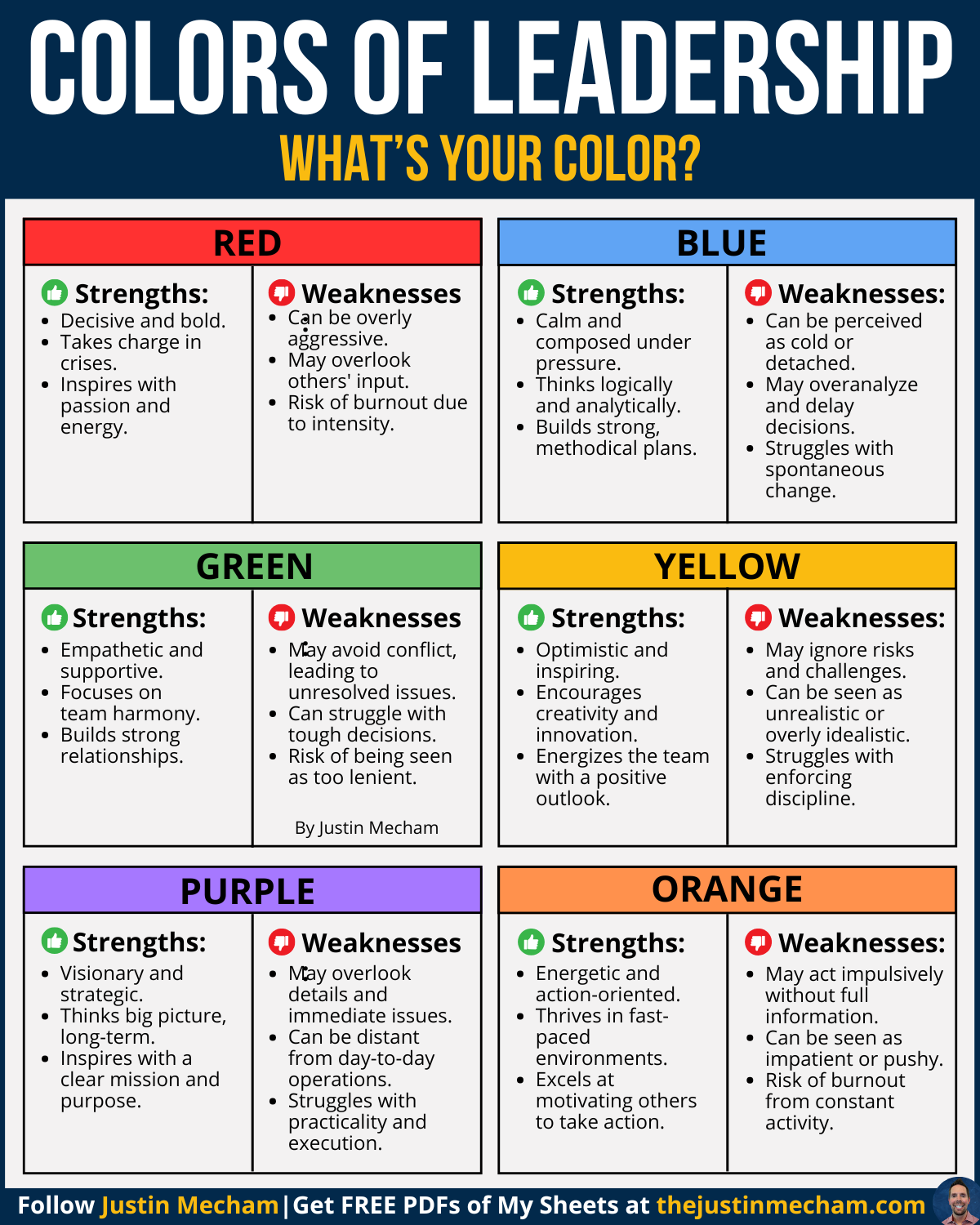
Download the Colors of Leadership Infographic (PDF)
If you want a visual guide to help identify and understand leadership styles, download the infographic connected to this article.
Download the Colors of Leadership infographic (PDF)
It’s a simple tool that helps leaders and teams name what’s already there—and lead with it more effectively.