Good Thinkers Know What to Think. Great Thinkers Know How to Think.
Most people don’t struggle because they lack ideas.
- They struggle because they rely on the same way of thinking for every situation.
- They plan when they should decide.
- They analyze when they should act.
- They brainstorm when they should narrow.
- They reflect when they should move.
That mismatch quietly creates frustration.
When the same problem keeps showing up, it’s usually not because the problem is complex.
It’s because the thinking style being used doesn’t match the moment.
Once you change how you think, the problem changes shape.
That’s the core idea behind the nine thinking styles.
Each one is useful.
Each one has a time and place.
And each one can either move you forward or keep you stuck, depending on when you use it.
Why One Thinking Style Isn’t Enough
Many teams and individuals fall into a pattern without realizing it.
Some default to execution.
They stay busy, move fast, and never step back to ask if the direction still makes sense.
Others default to analysis.
They gather data, map scenarios, and delay decisions until momentum fades.
Some live in ideas.
Others live in critique.
Few switch intentionally.
Great thinking isn’t about being smart.
It’s about choosing the right mental mode for the moment you’re in.
1. Execution Thinking: When Speed Matters More Than Perfection
Execution thinking is about movement.
It’s the right mode when:
- You already know what to do.
- Progress is blocked by hesitation.
- A task feels heavier than it needs to be.
This style breaks work into small, clear steps and adds light deadlines to create motion.
A Real Example
I worked with a team that had solid plans but nothing was shipping.
Every meeting ended with more discussion and better outlines, but no finished work.
We stopped planning and switched to execution thinking for one week.
Each task was broken into three actions.
Each action got a short deadline.
No revisiting decisions unless something was clearly broken.
Within days, progress returned.
Not because the ideas changed, but because action finally had priority.
Execution thinking isn’t about speed for its own sake.
It’s about clearing friction when clarity already exists.
2. Innovative Thinking: When Old Answers Aren’t Working
Innovative thinking is about breaking patterns.
It’s useful when:
- The same solution keeps failing.
- The market feels crowded.
- The problem doesn’t respond to standard fixes.
This mode allows unusual combinations and fast idea generation without judgment.
How It Shows Up In Real Work
A consultant I worked with kept offering the same service everyone else was selling.
Results were average, and interest was flat.
We ran a short innovative session.
Ten ideas.
No filtering.
No critique.
Then we combined two unrelated ones.
That mash-up became a new offer that stood out immediately.
Innovative thinking works best when it’s time-boxed and intentional.
Used too long, it creates chaos.
Used at the right time, it unlocks options.
3. Decision Thinking: When Clarity Beats Certainty
Decision thinking is about choosing.
It’s necessary when:
- You’ve gathered enough information.
- Debate keeps looping.
- Progress depends on commitment.
This mode cuts through noise and moves forward without waiting for perfect answers.
A Common Block
Teams often stay stuck because they confuse thinking with deciding.
I’ve seen teams list pros and cons endlessly, hoping clarity would appear.
Instead, we shifted to decision thinking:
Write the pros and cons side by side.
Pick one option.
Take the first step within 24 hours.
Momentum followed because commitment replaced discussion.
4. Critical Thinking: When Something Feels Off
Critical thinking challenges assumptions.
It’s useful when:
- A plan looks good but feels wrong.
- Everyone agrees too quickly.
- Risk is hidden under confidence.
This mode asks hard questions and examines what’s missing.
In Practice
During a strategy review, a team was excited about a new initiative.
Everything looked solid on paper.
We paused and asked:
- What are we assuming is true?
- What would someone who disagrees say?
That pause revealed a dependency no one had named.
Fixing it early prevented weeks of rework later.
Critical thinking isn’t negativity.
It’s care applied at the right time.
5. Analytical Thinking: When You Need to See the Chain Reaction
Analytical thinking traces cause and effect.
It’s helpful when:
- Outcomes feel unpredictable.
- Results don’t match effort.
- Systems feel messy.
This style breaks problems into parts and maps what leads to what.
A Team Example
A team couldn’t understand why output kept dropping.
Instead of guessing, we mapped the workflow step by step.
One small bottleneck was slowing everything downstream.
Fixing that single point improved the entire process.
Analytical thinking brings order when confusion rules.
6. Strategic Thinking: When Today Affects Tomorrow
Strategic thinking zooms out.
It’s essential when:
- Short-term wins threaten long-term goals.
- Teams are busy but misaligned.
- Growth feels scattered.
This mode connects today’s choices to future outcomes.
What This Looks Like
I worked with a founder who said yes to every opportunity.
Revenue was coming in, but focus was gone.
We turned each idea into a one-line story:
If we do this now, where does it lead next?
Several ideas were removed immediately.
Strategic thinking created alignment by filtering what didn’t fit the bigger direction.
7. Expansive Thinking: When You Need More Options
Expansive thinking increases volume.
It’s useful when:
- Solutions feel limited.
- You’re choosing too quickly.
- Creativity feels blocked.
This mode delays judgment to allow range.
How It Helped
A team was stuck between two weak options.
Instead of choosing, we expanded.
Every idea went on the list.
Even bad ones.
The final solution came from idea number twelve.
Expansive thinking works best before decisions, not after.
8. Reflective Thinking: When Experience Needs Meaning
Reflective thinking looks backward.
It’s valuable when:
- You keep repeating the same mistake.
- Wins feel accidental.
- Learning feels slow.
This mode turns experience into insight.
In Real Life
After a failed launch, a team wanted to move on quickly.
We stopped and asked:
- What worked?
- What didn’t?
- Why?
One pattern stood out and shaped the next launch.
Reflection didn’t slow them down.
It saved them from repeating the same errors.
9. Systems Thinking: When Everything Feels Connected
Systems thinking looks at relationships.
It’s needed when:
- Fixing one issue creates another.
- Problems keep returning.
- Change in one area affects many others.
This mode sees loops, not isolated events.
A Clear Example
A company kept hiring to fix overload.
But overload kept returning.
Mapping the system showed the real issue: unclear priorities, not headcount.
Fixing the root loop changed everything.
How To Use This In Real Life
The mistake isn’t using the wrong thinking style.
It’s using only one.
Try this:
- Pick a real problem.
- Ask which thinking style you’re using by default.
- Then switch.
The shift alone often reveals what was invisible before.
Tools That Support Better Thinking
Book: Thinking, Fast and Slow by Daniel Kahneman
Explores how different modes of thinking shape decisions.
TED Talk: How to Make Hard Choices by Ruth Chang
Clarifies decision-making when options feel equal.
AI Tool: Notion AI
Helps switch between outlining, analysis, and synthesis quickly.
Simple Tool: Miro
Great for mapping systems, ideas, and relationships visually.
Thinking Is a Skill You Can Change
The Difference That Actually Matters
Most people believe their thinking style is fixed.
It’s not.
You don’t need better ideas.
You need better alignment between the problem and how you approach it.
When you slow down to choose how to think, you stop forcing progress.
You stop fighting the problem.
You start seeing it clearly.
Clarity doesn’t come from effort alone.
It comes from using the right mental lens at the right time.
And once you see that, you don’t just solve better.
You work with more calm, more confidence, and far less friction.
That’s what great thinkers do differently.
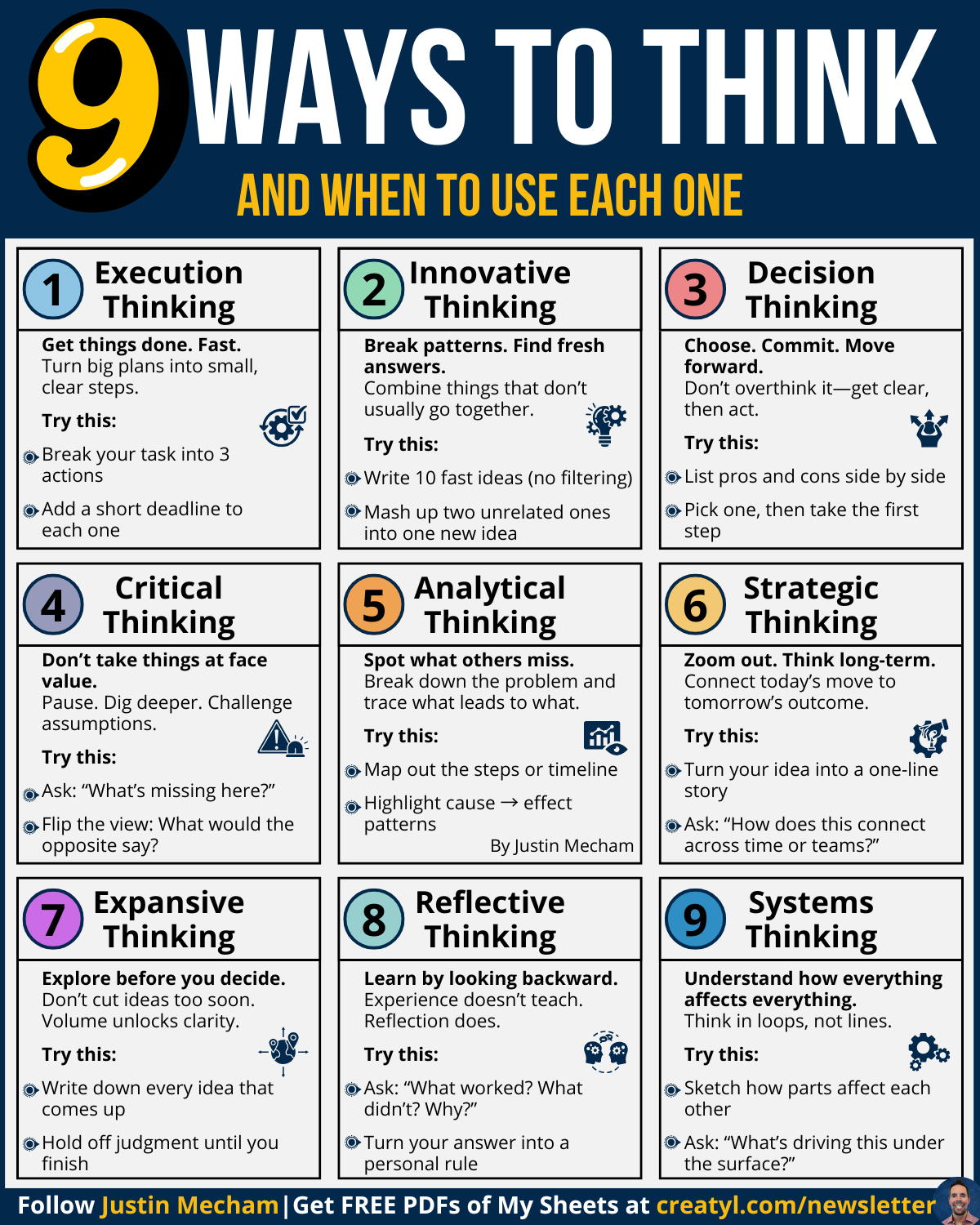
Download the “9 Ways to Think” Infographic (PDF)
Some frameworks are easier to use when you can see them clearly.
The “9 Ways to Think” infographic lays out each thinking style and when to use it on one page, making it easier to pause, reset, and choose the right approach in real time.
Many readers keep it nearby as a reference when they feel stuck or overwhelmed by a problem that won’t move.