Click Here to Download the PDF
Most people grow up believing that confidence arrives before action.
They think there’s a moment when everything inside them will suddenly feel ready.
They wait for a spark, a sign, or a sense of certainty that tells them it’s finally time to start.
But that moment rarely comes.
And when it doesn’t, people assume something must be wrong with them.
What no one tells you is that self-belief isn’t a feeling.
It’s not chemistry.
It’s not personality.
It’s not luck.
Self-belief is a skill.
And like any skill, it’s built through repetition, small steps, uncomfortable moments, and real evidence that you can do hard things even when you don’t feel ready.
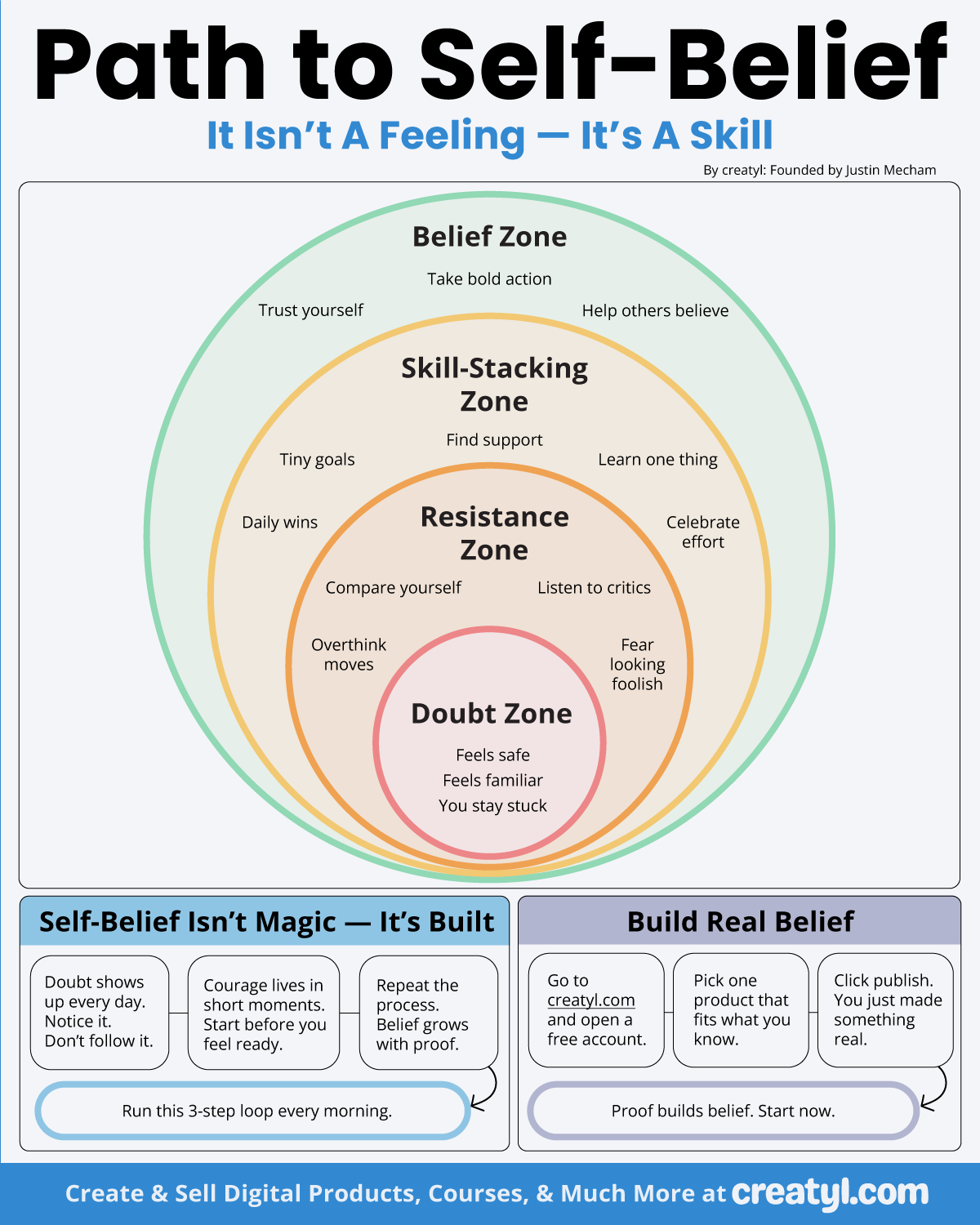
The infographic you saw earlier outlines the four phases people actually move through: the Doubt Zone, the Resistance Zone, the Skill-Stacking Zone, and the Belief Zone.
These are not motivational ideas—they’re patterns you see in people across careers, industries, and backgrounds.
They describe what it looks like to go from stuck to moving, and from moving to growing.
This article takes you through that journey with honesty, clarity, and a real-world example of how this plays out in workplaces.
You’ll also find tools, books, and frameworks that support this kind of growth and a final thought designed to stay with you long after you finish reading.
Why Most People Build Self-Belief Backwards
The biggest misunderstanding about self-belief is this:
People think they must feel confident before they act.
But every study on human behavior shows the opposite.
People gain confidence after they act.
Small steps produce wins.
Wins produce proof.
Proof produces belief.
Belief produces bigger action.
That’s the real cycle.
When you think about times in your life when you felt genuinely confident, it never happened before you tried something.
It happened after you saw yourself doing it.
Confidence grows from evidence.
The problem is that most people never collect enough evidence.
They stay in hesitation, stuck between wanting change and fearing what change demands.
They spend their days in the Doubt Zone, waiting for courage instead of building it.
This is why the four zones matter so much.
They make the process feel honest, human, and understandable—something anyone can do.
The Four Zones of Building Self-Belief
Below is a deeper look into each zone, written in a longer, more grounded way.
1. The Doubt Zone
Doubt feels safe because it requires nothing.
No risk. No visibility. No discomfort.
But it also guarantees that nothing changes.
In this zone, people:
- Overthink every decision
- Compare themselves to everyone else
- Worry about looking foolish
- Tell themselves they lack skill, clarity, or talent
The problem isn’t that doubt exists.
The problem is that doubt becomes the default.
The longer someone stays here, the more their goals feel out of reach.
2. The Resistance Zone
This is where you start to move, but everything feels heavy.
Every step requires effort.
Every action brings up questions.
Critics—both internal and external—get louder.
You second-guess yourself at every turn.
But something important happens here:
You begin to celebrate effort instead of judging outcomes.
This is the first sign of growth.
3. The Skill-Stacking Zone
Momentum begins here.
You learn one skill at a time, gather small wins, and start to see yourself differently.
Every task you complete becomes proof.
Every tiny win adds weight to your belief.
Support matters in this zone.
Mentors. Friends. Coaches. Communities.
People gain self-belief faster when they’re not building it alone.
4. The Belief Zone
Once enough proof has stacked up, something shifts.
You take bold actions you would have avoided months earlier.
You trust yourself more.
You begin helping others do what you once struggled to do.
This zone isn’t about loud confidence. It’s about quiet certainty.
A Real Workplace Example
How a Team Member Went From Self-Doubt to Self-Belief
A product designer at a tech company reached out to me because they felt stuck in their role.
They had talent, experience, and strong ideas—but when it came to presenting their work or pitching new concepts, they froze.
They constantly compared themselves to senior designers.
They worried about saying the wrong thing.
They hesitated to share their ideas in meetings.
This affected their performance reviews, their visibility, and their confidence.
They were stuck in the Doubt Zone, waiting for confidence to magically appear.
As we talked, it became clear they weren’t failing because of a lack of skill.
They were failing because of the story they told themselves.
Every meeting reinforced their fear.
Every hesitation strengthened their doubt.
And the longer they stayed silent, the more they believed they had nothing valuable to add.
They worked late nights reworking designs they were too afraid to present.
They watched others gain recognition and opportunities simply because they spoke up.
Their confidence wasn’t shrinking because they weren’t good enough.
Their confidence was shrinking because they never gave themselves a chance to build proof.
We created a small, simple process based on the four zones:
First, we named the doubt.
They wrote down every fear on paper.
Not to solve it—just to see it clearly.
Second, we created one action they could take before they felt ready.
Their first step wasn’t presenting a big idea.
It was asking a single clarifying question in a meeting.
The step was small enough to execute but meaningful enough to create proof.
Third, we celebrated every win.
Each time they spoke, even for a moment, we marked it as progress.
These wins mattered more than the perfection they chased.
Fourth, we added one new skill each week.
One week it was how to communicate design rationale.
Another week it was how to share work-in-progress without fear.
Another week it was how to create a simple pitch deck.
The wins stacked.
The skills stacked.
And the belief stacked.
Three months later, they led their first design review.
Not because they woke up feeling ready—but because they built enough proof to trust themselves.
Self-belief didn’t happen to them.
They built it from the inside out.
The Best Tools to Support the Self-Belief Journey
Book — The Confidence Gap by Russ Harris
A widely respected book that teaches people how to act with courage even when confidence is low. It explains why waiting to feel ready keeps people stuck and how real confidence grows through action.
TED Talk — The Power of Believing You Can Improve by Carol Dweck
Dweck’s talk is one of the most influential perspectives on self-belief. She breaks down why growth happens when you focus on progress instead of perfection and why effort is evidence of potential.
AI Tool — Headspace
Headspace helps people build emotional resilience through short, practical sessions focused on quieting internal noise, reducing self-doubt, and strengthening emotional awareness—key ingredients of the Resistance and Skill-Stacking zones.
Podcast — The Mindset Mentor by Rob Dial
A top-ranked show that breaks mindset into simple, accessible insights. Many episodes discuss courage, proof-building, and taking action despite fear.
Movie — The Pursuit of Happyness
A powerful depiction of how belief is built through persistent effort, small wins, and the refusal to let setbacks define your potential.
A Practical Framework: The Loop That Builds Real Belief
The fastest way to build self-belief is through a simple loop you repeat daily:
Step 1: Notice doubt without following it
Doubt is automatic.
It will show up whether or not you invite it.
Your job is to witness it, not obey it.
Step 2: Act before you feel ready
Every meaningful action happens slightly earlier than comfort would prefer.
That’s not a flaw—it’s the doorway into growth.
Step 3: Repeat the process daily
Consistency gives you proof.
Proof gives you belief.
Belief gives you momentum.
If you follow this loop, belief becomes a natural byproduct of your actions.
The Quiet Work That Turns Doubt Into Direction
There is a moment in everyone’s life when they realize doubt isn’t going away.
It doesn’t disappear with age or success or experience.
Doubt evolves, changes shape, and shows up at new levels of your growth.
The people who build real self-belief are not the people who silence doubt.
They are the ones who stop letting doubt decide the direction of their lives.
Self-belief grows when you give yourself permission to move without certainty.
It grows when you allow small wins to matter.
It grows when you choose progress over perfection.
It grows when you let effort be enough for today.
And it grows when you stop waiting for a feeling that was never meant to come first.
You build belief slowly, through the kind of work no one sees—those small, unglamorous steps that quietly reshape who you think you are.
Every time you try, even imperfectly, you gather proof that you can carry more than you thought.
You begin to trust yourself in ways that once felt impossible.
You start to move through the world with a steadiness that doesn’t need applause to feel real.
Growth doesn’t require certainty.
Self-belief doesn’t require confidence.
All it requires is a willingness to show up before you feel ready and to let each step become evidence that you’re becoming someone you can trust.
Your belief begins the moment you decide your doubt no longer gets the final say.
Download the Infographic as a PDF
You can download the complete “Path to Self-Belief” infographic in a clean, printable PDF format here: