Click Here to Download the PDF
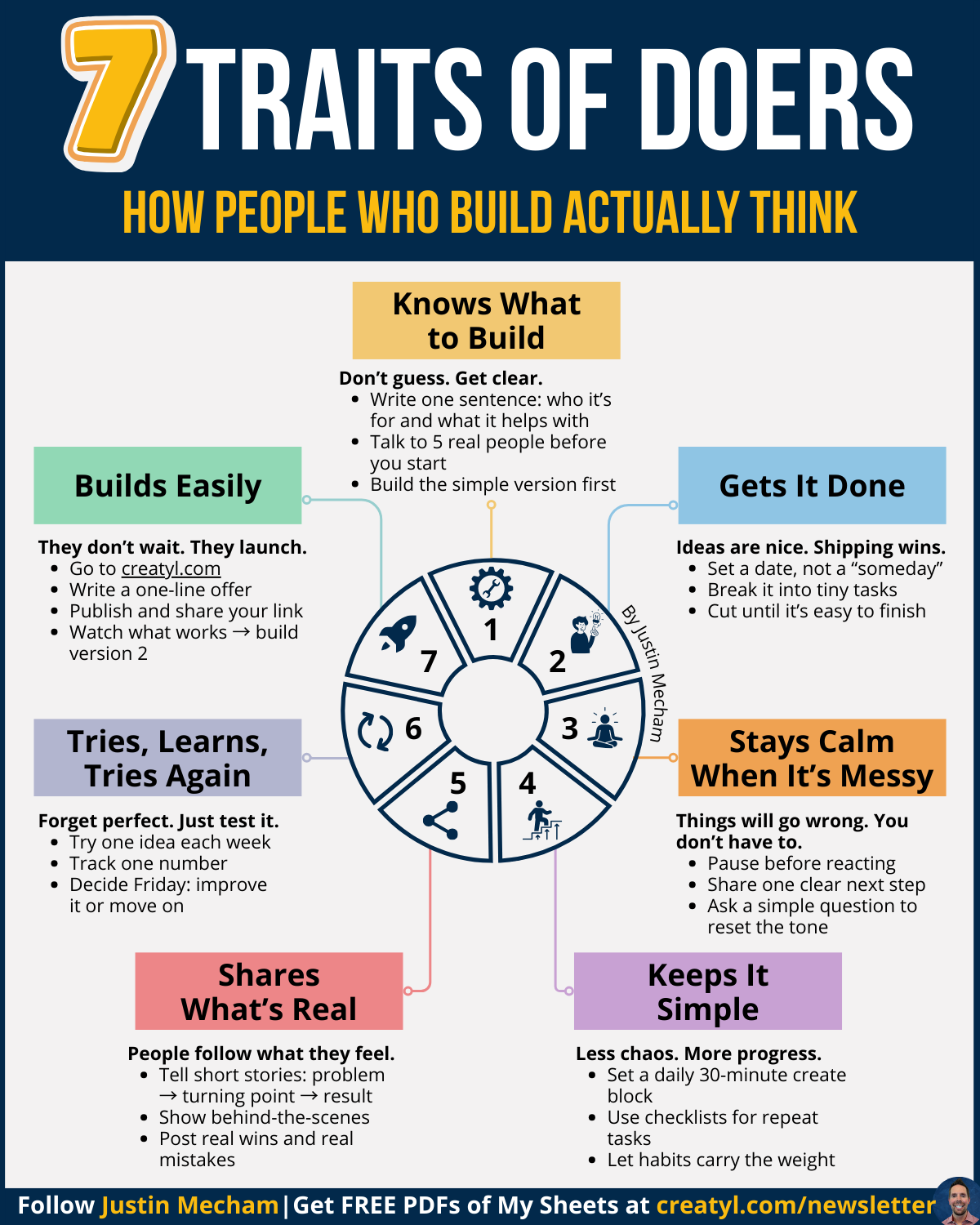
The 7 Traits of Doers: How People Who Build Actually Think
Most people want to create something meaningful.
They want to build, ship, publish, or launch something of their own. Yet they wait.
They wait for perfect timing, perfect clarity, perfect certainty, or perfect confidence.
They imagine big outcomes but stall when it’s time to begin.
Doers live differently.
They don’t wait for clarity — they create it by moving.
They don’t look for perfect conditions — they use what they have.
They don’t build once — they build, adjust, rebuild, and move again.
This article breaks down how doers actually think, what makes them different from the people who stay stuck planning, and how you can adopt the same mindset to move faster, work smarter, and get results without waiting for the stars to align.
Every section has been expanded, written in a grounded, human voice, and designed to help readers understand why these traits matter — and how to use them in real life.
1. Doers Know What to Build
Doers don’t guess.
They don’t build in the dark.
They get clear before they start, and that clarity makes the work lighter.
They don’t spend months planning a massive version of something no one asked for.
They strip the idea down to its core:
Who is it for?
What problem does it solve?
What’s the simplest version that still works?
Doers talk to real people before they build, not after.
They ask questions. They listen for patterns.
They test their thinking with real conversations instead of assumptions.
When they begin, they start small — not because they think small, but because the small version reveals what actually matters.
They let real feedback shape version two, not imagination.
This is why doers move.
They don’t wait for clarity — clarity comes from talking, testing, and starting.
2. Doers Get It Done
There’s a major difference between having ideas and doing something with them.
Ideas feel exciting because thinking feels clean and safe.
But doers know that nothing matters until it ships.
Finishing is what separates movement from daydreams.
Doers set real dates.
Not wishes, not “somedays,” not soft commitments that shift when things feel inconvenient.
They put deadlines on the calendar because deadlines create motion.
They break work into pieces so small that finishing becomes possible.
Instead of carrying a heavy project that feels impossible to complete, they cut until it’s simple.
They know progress grows with small steps, not big leaps.
Doers are not obsessed with perfection.
They are obsessed with completion — because completion gives them data.
And data gives them direction. And direction gives them speed.
3. Doers Stay Calm When It’s Messy
Building anything worth creating will get messy.
Something will go wrong.
A plan will fall apart. A step will take longer. A file will fail. A conversation will stall.
This is normal. The difference is how doers respond.
Doers don’t panic at the first sign of friction.
They take a breath.
They pause before reacting.
They choose the next clear step instead of spiraling into frustration.
They know the moment after something goes wrong is the moment that shapes the entire project.
Staying calm keeps the work moving. Losing control stops everything.
Doers also reset the tone on purpose.
When a moment feels heated or stressful, they ask a simple question, name the next move, or shift the energy so the work keeps going instead of collapsing.
They don’t deny difficulty.
They just don’t let it control the outcome.
4. Doers Keep It Simple
Complexity kills projects.
It slows action.
It increases stress.
It steals clarity.
Doers remove everything that doesn’t matter.
They choose simple systems over complicated plans.
They use short checklists instead of heavy processes.
They build daily habits that carry the weight instead of relying on motivation.
They keep their tools light. Their schedule grounded. Their steps small. Their decisions clear.
When the work is simple, the progress is faster.
When the work is heavy, everything stalls.
Doers don’t simplify because they want to rush.
They simplify because it creates consistency.
5. Doers Share What’s Real
People don’t follow perfection.
They follow honesty.
They trust what feels true.
Doers share their work openly — the wins, the setbacks, the attempts, the things they learned by trying.
They tell short, honest stories about real problems, the moment things changed, and the results that followed.
They don’t hide behind polished messages or high-level framing.
They let people see the actual process because the process is what people relate to.
Doers know that hiding mistakes creates pressure. Sharing them creates connection.
When you share what’s real, people feel something.
And people follow what they feel.
6. Doers Try, Learn, and Try Again
Perfection is the enemy of motion. Doers understand this more than anyone.
They test one idea a week — not ten.
They track one number — not twenty.
They decide what to improve and what to abandon.
They don’t get attached to an idea just because they spent time on it.
If something isn’t working, they learn from it and move on.
Doers don’t wait for the perfect idea because they know perfect ideas only reveal themselves through testing.
The more they try, the more they learn.
The more they learn, the better their decisions become.
And the better their decisions become, the faster they build things that actually work.
Letting go of perfect is not lowering standards.
It is raising speed, clarity, and accuracy.
7. Doers Build Easily
Doers don’t overthink. They launch.
They use simple tools. They write one sentence or one line.
They publish their link. They share their work instead of hiding it in drafts and folders.
They don’t obsess over being “ready.”
They move toward readiness by taking action.
Doers use platforms like creatyl to simplify the process.
Rather than building for months, they publish something small and see how people respond.
Once they know what works, they build version two — not before.
This trait matters more than anything else.
Ideas don’t change anything.
Action does.
The Moment a Team Stopped Planning and Finally Became Builders
I once worked with a team inside a growing company that spent months planning a new initiative that still hadn’t launched.
They had documents, notes, frameworks, diagrams, discussions, strategy sessions, and endless planning meetings.
On paper, they looked prepared.
In reality, nothing had moved.
The team didn’t lack talent.
They lacked movement.
They waited for total clarity, perfect alignment, and readiness that never arrived.
Every time they got close to starting, someone asked for one more revision, one more round of feedback, one more meeting.
The project felt heavy, and the longer it dragged, the harder it became to begin.
They were excellent planners — but they weren’t building.
And their planning was starting to create frustration, confusion, and stress across the company.
Over time, the team began to feel stuck.
People lost confidence.
Meetings became repetitive.
The pressure to get everything “right” turned into fear of making a mistake.
Instead of moving forward, they became more cautious.
More hesitant. More dependent on planning as a safety net.
Other teams grew impatient.
Leadership questioned the delay.
The team felt the weight of expectations without having anything tangible to show.
Every week felt the same: more preparation, more notes, more hesitation.
What they didn’t realize was that the problem didn’t come from their idea.
It came from their mindset.
They were thinking like planners — not builders.
I introduced them to the 7 Traits of Doers and rebuilt their process around action instead of perfection.
Here’s how we shifted their approach:
1. We clarified exactly what to build.
We wrote one sentence: who it was for and what it solved.
We talked to five real people.
We cut the idea down to its simplest form.
We built the smallest version first.
2. We set a real launch date.
Not a target.
A date.
It went on the calendar and couldn’t move.
3. We broke the project into tiny steps.
No giant tasks.
No vague blocks of time.
Just small, clear actions anyone could finish quickly.
4. We prepared for messiness.
We talked openly about what might go wrong.
We created a reset plan for when stress appeared.
We focused on staying steady instead of avoiding problems.
5. We simplified everything.
We removed extra steps.
We created short checklists.
We built daily habits that made progress automatic.
6. We shared the work publicly.
We posted real updates, small wins, and the honest parts of the process.
This built energy and kept everyone accountable.
7. We used creatyl to ship a simple version.
They wrote one line.
Published their link.
Launched the first version.
That one move changed everything.
The project launched within two weeks.
Momentum returned.
Confidence rose.
People felt energized.
And something important happened:
The team finally saw that clarity doesn’t come from endless planning — it comes from movement.
Once they became builders, not planners, everything changed.
The Moment You Stop Waiting and Start Moving
There’s a quiet turning point in every builder’s journey.
It happens when you stop waiting for certainty and start creating your own direction.
The gap between ideas and outcomes isn’t filled by more thinking.
It’s filled by movement.
The people who build know this.
They trust that clarity grows with every step, not before it.
You don’t need a perfect path to begin.
You need one clear sentence, one simple step, and the willingness to move even when the next part feels unclear.
Progress doesn’t reward the person who plans the longest.
It rewards the person who acts, observes, adjusts, and keeps going.
Doers aren’t reckless.
They’re courageous enough to begin before they feel ready.
They understand that everything becomes easier once momentum starts.
They accept that the work will get messy, and that messiness is part of the process — not a sign to stop.
The most important truth is this:
You don’t become a builder by thinking about the work.
You become one by doing the work.
Again and again.
Download the Infographic
If you want a clear, simple way to remember the 7 Traits of Doers, you can download the full infographic as a PDF.
It includes every point and detail from this article in one place.
Insert your PDF link here: