Click Here to Download the PDF
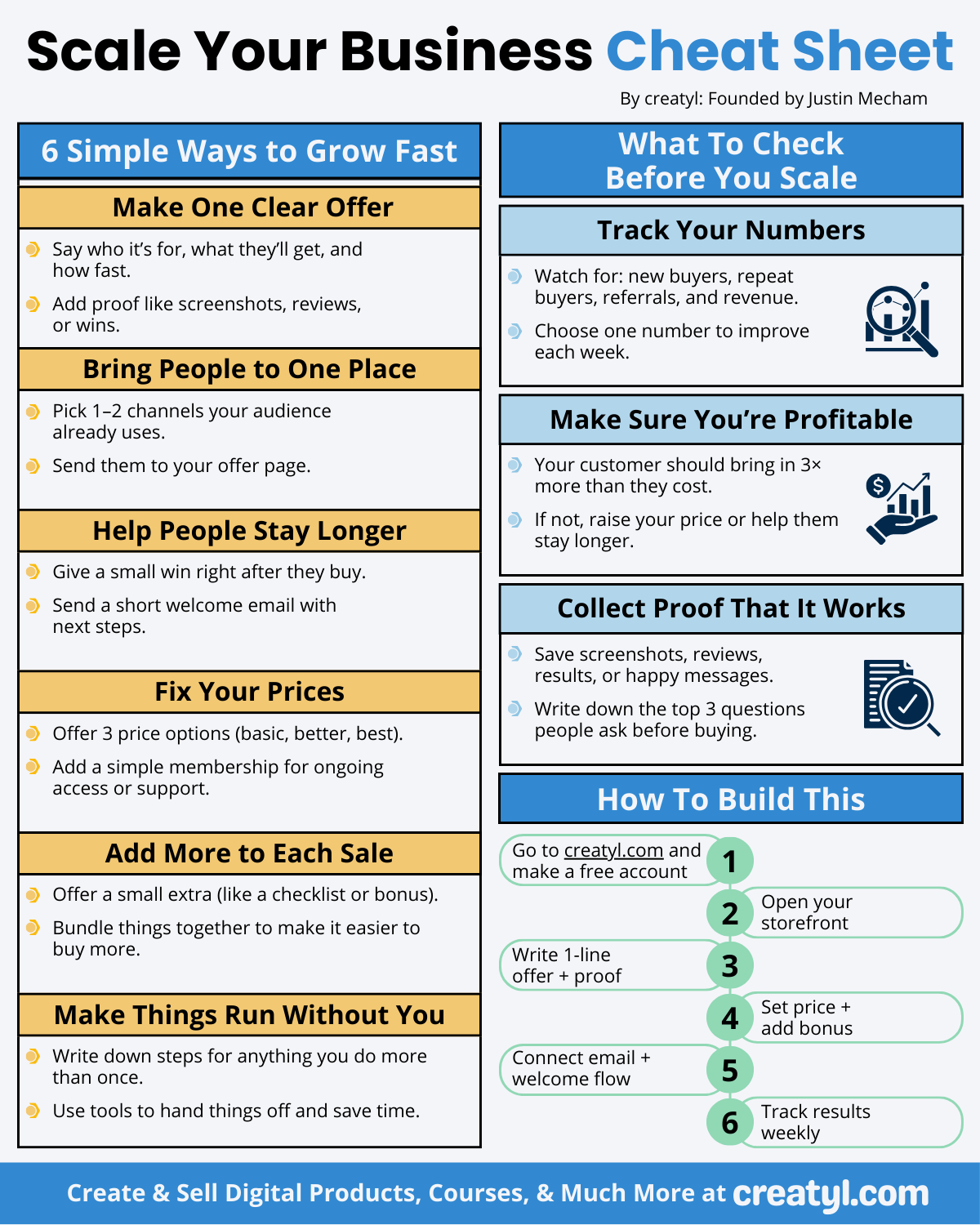
Scale Your Business by Doing Less, Better, and On Repeat
Most people think they need a brand-new product to scale.
They assume their offer is the problem.
They keep rewriting it, redesigning it, refreshing it, or replacing it.
But here’s the truth that becomes clear once you talk to enough creators, founders, and teams:
Most offers don’t need a makeover.
Most systems do.
Growth slows down not because people are selling the wrong thing, but because the way they sell it keeps changing.
There’s no repeatable path.
No consistent flow.
No structure that carries the weight.
Scaling becomes impossible because everything depends on the creator doing more.
More tasks. More content. More posts. More messages.
But scaling only happens when you do less — with more consistency, more clarity, and more repeatability.
This article is built to give you that structure.
It takes the full cheat sheet from the infographic and expands it into a long-form, practical, human-centered guide.
You’ll learn what actually makes an offer scalable, what most people overlook, and how a simple system can carry your business farther than any new idea.
And throughout, you’ll see expanded real workplace PAS examples so you can understand how these ideas work outside of online business too.
Make One Clear Offer: Clarity First, Complexity Later
The fastest way to slow your business down is to keep changing your offer.
The fastest way to grow it is to simplify the way you explain it.
A clear offer is direct.
It says who it’s for, what they get, what it solves, and how fast it works.
When people understand the promise quickly, they give you a chance.
When they see proof, they trust you.
This is why screenshots, wins, reviews, and simple stories matter so much.
They confirm that your offer delivers something real.
Most creators overthink their offer because they want it to feel new or impressive.
But people aren’t paying for impressive.
They’re paying for clarity.
They want to know what they’re getting and why it matters.
A clear offer becomes the foundation of a scalable system.
Because you can’t scale something you can’t explain.
Bring People to One Place: Focus Your Energy, Don’t Scatter It
Scaling isn’t about being everywhere.
It’s about being consistent in the right places.
Choose one or two channels where your audience already spends time.
Then send them all to one destination — your offer page.
This is how you tighten your funnel and keep your efforts from leaking energy.
When everyone arrives at the same place, the system stays simple.
You track one set of numbers.
You test one message.
You optimize one flow.
This focus creates momentum because you’re no longer chasing traffic from a dozen directions.
Most people make things harder than they need to be.
Growth becomes easier the moment you remove everything that pulls you off course.
Help People Stay Longer: Create a Real Experience After They Buy
Scaling isn’t just about getting more buyers.
It’s about keeping the ones you have.
A small win right after purchase creates connection.
A welcome email with clear next steps builds trust and comfort.
These little actions make people feel looked after.
And when people feel supported, they stay longer, buy again, share your work, and speak well of you.
This isn’t about adding more features. It’s about adding direction.
People want to know what to do next.
When you guide them, you increase their lifetime value without extra pressure.
Fix Your Prices: Give People a Clear Path to Choose
Your price isn’t supposed to be a puzzle. It’s supposed to help buyers make confident decisions.
Three options — basic, better, best — give people structure.
A membership option gives your business stability.
A structured price creates clarity for both sides.
When your pricing is simple and predictable, people feel safe choosing.
They understand the difference between tiers.
They see the value.
They can pick the level that fits their needs without confusion.
Clear pricing is the backbone of a scalable system.
Because structure creates predictability — and predictability creates growth.
Add More to Each Sale: Increase Value Without Increased Work
The goal isn’t to add more tasks.
It’s to add more value inside the tasks you already do.
A small checklist, a bonus, a helpful resource — these additions can lift your average order value without increasing your workload.
Bundles help buyers get more of what they need in one place.
This not only helps them but also increases your revenue per customer.
Scaling isn’t about selling more products.
It’s about increasing the value of each sale.
This is how businesses grow without burnout.
Make It Run Without You: Systems Are What Scale, Not People
If your business requires you every minute, it can’t grow.
If your business depends on steps that only you know, it can’t scale.
Writing down your repeatable steps is one of the most overlooked parts of growth.
Anything you do more than once should have its own process.
Once written, those steps can be automated or delegated.
This is where your business stops being held up by your time and starts being supported by your system.
Scaling happens when the system carries the weight — not the creator.
Before You Scale: The Checklist That Protects Your Growth
Scaling without checking your numbers is one of the fastest ways to break your business.
You need visibility before you add pressure.
Track buyers.
Track referrals.
Track revenue.
Track repeat purchases.
Choose one number to improve each week.
This keeps your growth controlled and intentional.
Your customer should bring in three times more than they cost.
If not, the system needs adjusting.
Save proof.
Reviews, screenshots, wins — these build trust and show you what people value most.
Scaling requires evidence, not excitement.
Real Workplace Examples: What This Looks Like in Real Life
Here are expanded, authentic examples of how the “system over product” concept plays out in the workplace.
The Employee With Ten Tasks but No System
A marketing employee handled ads, landing pages, emails, and content.
They were good at all of it, but everything lived in their head.
They created each email from scratch.
They rewrote ads every time.
They rebuilt landing pages for every campaign.
They worked long hours, yet growth felt slow.
They hit a point of exhaustion.
They were doing everything right but nothing felt sustainable.
Their team depended on them heavily, which meant every delay slowed the whole department.
Their stress increased.
Small mistakes began showing up because they were stretched thin.
They adopted the “Make It Run Without You” mindset.
They wrote steps for every recurring task.
They created email templates, ad templates, page outlines, and checklists.
They handed some of the steps to another team member.
They automated tasks that didn’t require creativity.
Within weeks, their workload dropped and their output increased.
Their company now had a system — not a single person — driving growth.
The Coach Who Thought They Needed a New Offer
A coach felt stuck.
Their main program wasn’t growing the way it used to, so they assumed the offer was outdated.
They considered changing it, rebuilding it from scratch, or adding more features.
They became overwhelmed.
Each new idea created more work.
They felt scattered, unfocused, and unsure.
Their income became inconsistent because they kept shifting directions.
Clients were confused as well.
They stepped back and looked at the system instead.
They simplified their messaging.
They sent everyone to one page.
They added a welcome flow.
They built a small bonus to make the offer feel complete.
They added a simple membership to support long-term clients.
Their offer didn’t change — their process did.
And within a few months, their sales increased because the system was working consistently.
The Founder Who Kept Lowering Their Prices
A founder believed their slow sales were caused by pricing.
Every time sales dipped, they lowered the price.
But nothing improved.
They felt discouraged.
They wondered if their product wasn’t good enough.
They started thinking about replacing the product entirely.
Their confidence dropped, and they questioned if the business was even worth continuing.
They applied the “Fix Your Prices” and “Add More to Each Sale” principles.
They built three clear options.
They added a small bonus that solved a common problem.
They introduced a membership option.
Their offer suddenly felt structured and valuable.
Buyers understood it better and chose the middle option often.
Their revenue increased without needing new products.
The Creator Who Posted Everywhere but Saw No Results
A creator posted on every platform they could think of — Instagram, TikTok, LinkedIn, YouTube, and Twitter.
They hoped the wide reach would improve sales, but engagement stayed flat.
They felt embarrassed and exhausted.
They saw others succeeding with half the content.
They questioned their skills and wondered if they were simply not built for online business.
They applied “Bring People to One Place.”
They chose two channels their audience already used.
They drove all traffic to one offer page.
They made their messaging clearer and more direct.
And without doing more, they saw more signups because the system was no longer scattered.
Their efforts finally led somewhere.
Growth Begins When the Work Finally Feels Manageable
Scaling isn’t about bigger ideas or more energy.
It isn’t about rushing into complexity.
It begins the moment your business becomes simple enough to repeat without effort.
When your offer is clear, your system becomes predictable.
When your steps are documented, you stop relying on momentum to stay consistent.
When your process is focused, your results become stable.
Most people believe growth requires pressure.
But real, sustainable growth starts from clarity — the kind that removes tension instead of adding it.
The kind that makes you feel in control again.
The kind that lets you focus on the work you actually enjoy instead of the work that drains you.
When your system runs smoothly, your confidence returns.
You stop questioning every step.
You stop searching for a new direction.
You start believing that your idea can carry you forward because you finally built the structure that can carry it.
You don’t scale by working harder.
You scale by building something steady enough to support you.
The moment you choose clarity over chaos, you give your business the chance to grow in a way that feels calm, grounded, and real.
Download the Infographic
You can download the full “Scale Your Business Cheat Sheet” infographic as a PDF and keep all the steps together.