Click Here to Download the PDF
There’s something most people don’t realize about building a profitable online business:
it’s not the number of ideas you have that determines your success.
It’s how clearly you can communicate the one idea that actually matters.
The truth is simple.
Most people aren’t stuck because they lack creativity or skill.
They’re stuck because everything they’re doing feels loud, scattered, and overwhelming.
They’re drowning in concepts, projects, messages, tools, and tasks that all feel important but never quite connect into anything people can buy or understand.
Confusion doesn’t just slow you down.
It quietly erases your progress until it feels like nothing is working.
Clarity, on the other hand, is what gives your work direction.
It helps you explain what you do in a way that makes sense.
It helps your audience know if your product is for them.
It helps you stop second-guessing and start building something you can actually finish.
This entire article is built around one powerful truth:
Most people don’t need more ideas.
They need one simple idea that is clear enough to sell.
What follows is a breakdown of how clarity actually works, why it matters more than motivation, and how you can use it to build something profitable without lifting the heaviest load or complicating every decision.
Each section is expanded, grounded, and written with the intention of helping you feel seen, understood, and guided step by step.
And woven throughout are real-life workplace stories so you can see how these concepts work outside the world of online business too.
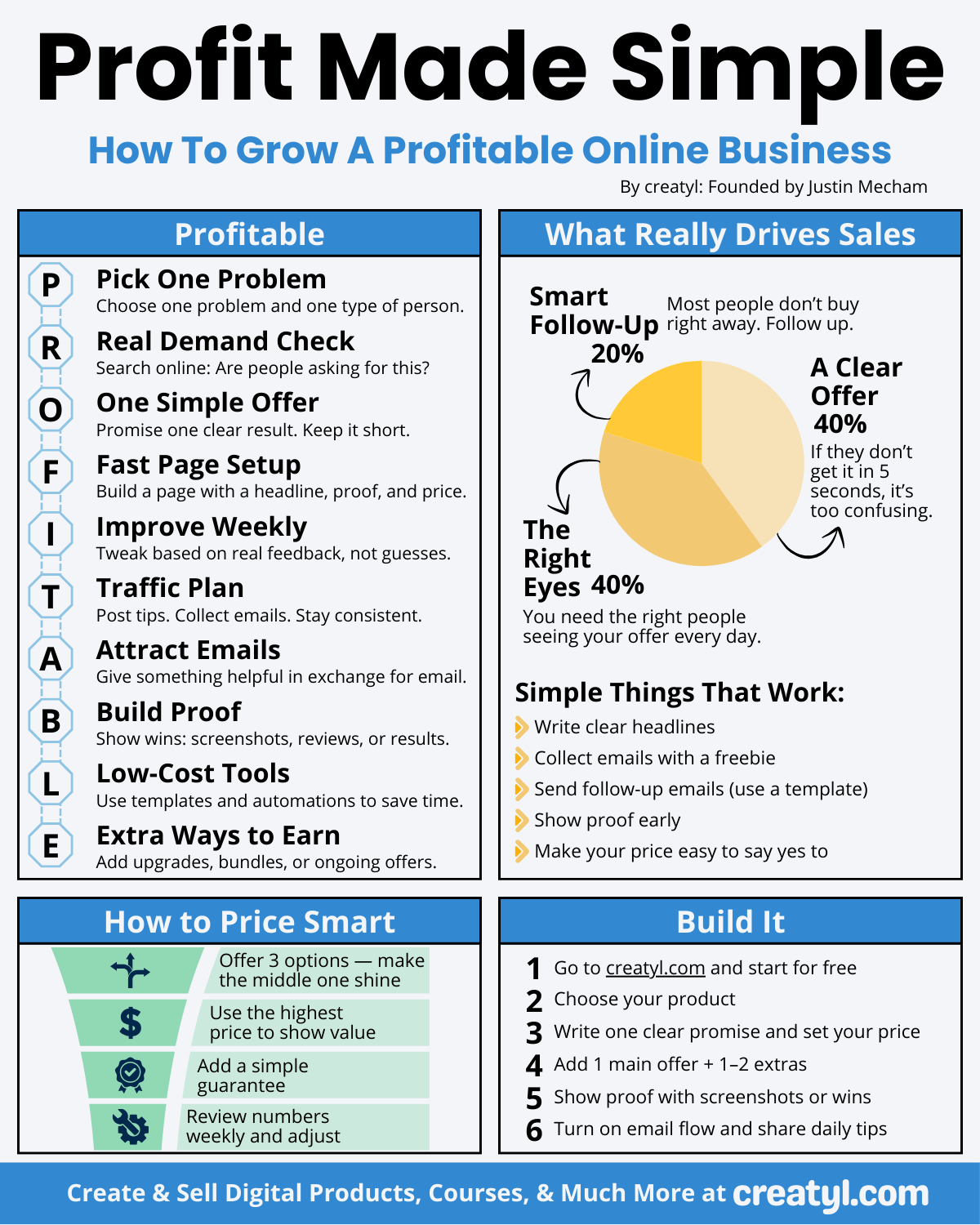
Start Simple: One Problem, One Person, One Promise
Here’s what most people get wrong when starting an online business — they try to solve too much too soon.
They want their product to do everything because they don’t want to miss anyone.
But the moment your offer tries to appeal to everyone, it stops appealing to anyone.
Starting simple doesn’t mean starting small.
It means choosing a level of focus that makes it impossible for people to misunderstand you.
When you start with one clear problem, you avoid the trap of trying to outdo your own ideas.
When you choose one person to serve, you stop guessing what people want.
And when you make one promise, you remove the pressure to explain ten different outcomes.
You give people something solid, direct, and easy to say yes to.
Checking demand becomes straightforward.
You no longer search the internet trying to validate a dozen directions at once.
You simply look for proof that real people are already trying to solve the problem you want to solve.
When you see that desire clearly, you gain confidence that your idea can actually work.
This is the beginning of a business that doesn’t rely on luck.
It relies on clarity — and clarity is what opens the door to progress.
Keep Improving: Why Real Feedback Matters More Than Opinions
Once you’ve built your first version, the next step isn’t to redesign everything.
It’s to listen, observe, and refine.
A profitable business isn’t created in one moment.
It grows through steady adjustments rooted in real feedback.
Most people get stuck because they’re surrounded by opinions.
Friends, coworkers, strangers online — everyone has thoughts about what your product should do.
But opinions don’t equal insight.
The only feedback that matters comes from the people who might actually buy.
This is why posting consistently and communicating regularly matters.
You learn what people respond to.
You learn what questions they ask, what they ignore, what they click, and what they repeat back to you.
You begin to see patterns.
These patterns show you where to improve.
Sharing small wins early helps people trust you.
People don’t need perfection.
They need proof that you’re moving.
They need signs that you’re real.
And as your product grows, adding small upgrades over time keeps things simple and manageable.
Improvement is not a giant leap.
It’s a series of small steps — each one clearer than the last.
Simple Things That Work: The Easy Wins Most People Skip
Even the strongest ideas fall apart when they’re hard to understand.
That’s why small clarity shifts often lead to the biggest growth.
Clear headlines help people immediately see your promise.
Giving away a free resource helps you attract the right audience instead of random views.
Follow-up templates make your communication steady even during busy weeks.
And early proof shows people that your promise is real.
The reason these steps work so well is because they reduce friction.
When your message is easy to understand, people stay.
When they stay, they trust.
And when they trust, they buy.
Most buyers don’t make decisions slowly.
They make decisions quickly — when the message is clear enough.
This is the difference between constant effort that goes nowhere and steady work that feels meaningful.
How to Price Smart: Help People Choose With Confidence
Pricing doesn’t have to be a guessing game.
When people hesitate, it’s rarely about the number.
It’s about what the number represents — safety, clarity, and trust.
Offering three pricing options helps people compare.
Highlighting the middle option shows them the most balanced choice.
Using a high-priced anchor gives the lower prices context.
A simple guarantee removes fear and gives people room to take action without second-guessing.
Reviewing your numbers weekly lets you adjust based on real patterns instead of assumptions.
Smart pricing is communication.
It tells people who the product is for, what they can expect, and why the offer makes sense.
When people understand your structure, they feel confident choosing you.
Real Workplace Examples: What Clarity Looks Like in Action
Here are expanded real-life workplace examples.
These go beyond theory and show you how clarity changes outcomes in everyday situations.
The Team Stuck With Too Many Ideas
A cross-functional team kept launching new project ideas month after month.
Each idea felt exciting in the moment, but none were carried to completion.
They created pitch decks, outlined strategies, and mapped out timelines — but everything stayed in planning mode.
Leadership wanted progress, but the team was drowning in competing priorities.
The team started to feel worn down.
They had long meetings where everyone spoke but nothing was decided.
Every project felt urgent but none were moving.
Deadlines were pushed.
Updates became vague.
The team didn’t feel proud of their work because it felt like nothing was ever finished.
Morale faded slowly.
They weren’t unskilled or unmotivated — they were directionless.
They used the “Start Simple” clarity framework.
They pulled together customer requests, complaints, and survey data and identified the one problem that appeared repeatedly.
They confirmed demand by reviewing support logs and comparisons with competitors.
Then they created one focused project plan with one defined promise.
They laid out the result, timeline, responsibilities, and early proof.
A simple internal page replaced months of scattered documents.
Within weeks, the entire workflow felt lighter.
People knew exactly what mattered.
The project shipped ahead of schedule, and leadership praised the team for their clear direction.
The team finally saw momentum because the noise had been removed.
The Client Who Always Requested More
A freelance marketer worked with a client who constantly asked for extra tasks that weren’t originally part of the agreement — rewriting full websites, creating new graphics, adding research, running small campaigns.
It stretched the project far beyond scope.
The freelancer felt burned out.
Their workdays felt unpredictable because every new message brought a new request.
They started to resent the project.
The client never intended to take advantage — they just didn’t know where the boundaries were because the offer wasn’t clear.
The freelancer rebuilt everything using the “One Clear Promise” approach.
They created a simple offer page listing exactly what was included.
They added an “excluded” list to avoid confusion.
They structured three pricing tiers and highlighted the middle one as the best fit.
The highest tier created context so the middle tier felt safe.
A simple guarantee helped the client feel confident choosing the right option.
When they presented the new offer, the client understood immediately.
They picked the middle tier, respected the boundaries, and the project became smooth and predictable.
The freelancer used this clarified structure with every new client and noticed issues nearly disappear.
The Team Member With High Effort but Low Results
A team member posted daily about their company’s digital product.
Their content was well-designed, thoughtful, and consistent — yet almost no one clicked, commented, or signed up.
They felt invisible.
They watched others in the industry grow faster with less effort.
They questioned their skills and the product itself.
They worked long hours creating content that didn’t move the needle.
Their confidence took a hit, and they started to wonder if they were simply doing something wrong.
They adopted the “Simple Things That Work” method.
They rewrote their headlines to be shorter and clearer.
They offered a free download so interested people had a reason to join the email list.
They used follow-up templates to stay steady even on busy days.
They added early screenshots of user wins for social proof.
Within days, signups increased because the message finally made sense.
They realized the issue was not effort — it was clarity.
Once they fixed the messaging, everything became smoother.
The Manager With a Team That Couldn’t Stay on Track
A department manager led weekly meetings, but the team left confused about what to do next.
Some tasks overlapped.
Some tasks were missed entirely.
Deadlines slipped.
People worked hard but in the wrong direction.
The manager felt drained.
They rewrote plans, clarified tasks, created new documents, and sent follow-up emails — yet nothing changed.
Team members were afraid to ask questions because they didn’t want to seem unprepared.
The problem wasn’t skill. It was unclear direction.
The manager shifted to the “Price Smart” framework but adapted it internally.
For each project, they created three clear execution options with a simple explanation of what each option solved.
The middle option became the default choice.
The highest option created clarity about the effort required.
Weekly reviews reinforced direction.
The team suddenly had clarity.
Meetings became shorter.
Tasks were completed without confusion.
The team felt more confident and aligned.
The Space Clarity Creates
Clarity is more than structure or strategy.
It is the moment you stop chasing complexity and give yourself permission to build something real.
It is the space you create around your work so you can finally think, act, and move without pressure.
Most people struggle because they are building in chaos.
Their ideas are good.
Their intentions are good.
Their effort is real.
But everything feels heavy because nothing feels defined.
When you remove the noise, you don’t just clean up your process — you reclaim your energy.
You reclaim your confidence.
You reclaim your sense of direction.
Clarity makes room for honest work.
It makes room for ideas that can stand on their own.
It makes room for progress that doesn’t drain you.
And it makes room for the version of you who doesn’t have to question every move because the next step is finally obvious.
Your most profitable idea is rarely the one you think up tomorrow.
It is the one you’ve been carrying for a long time — the one you haven’t given a clear runway.
When you choose clarity, you give that idea a real chance to succeed.
You give yourself a real chance to succeed.
And that is where long-term profit begins.
Not from big moves. Not from more ideas.
But from work that finally makes sense.
Download the Infographic
You can download the full “Profit Made Simple” infographic as a PDF and keep all the steps in one place.